Chapter III
The Program That Edits Itself
Three things brains do that engineered systems mostly don't
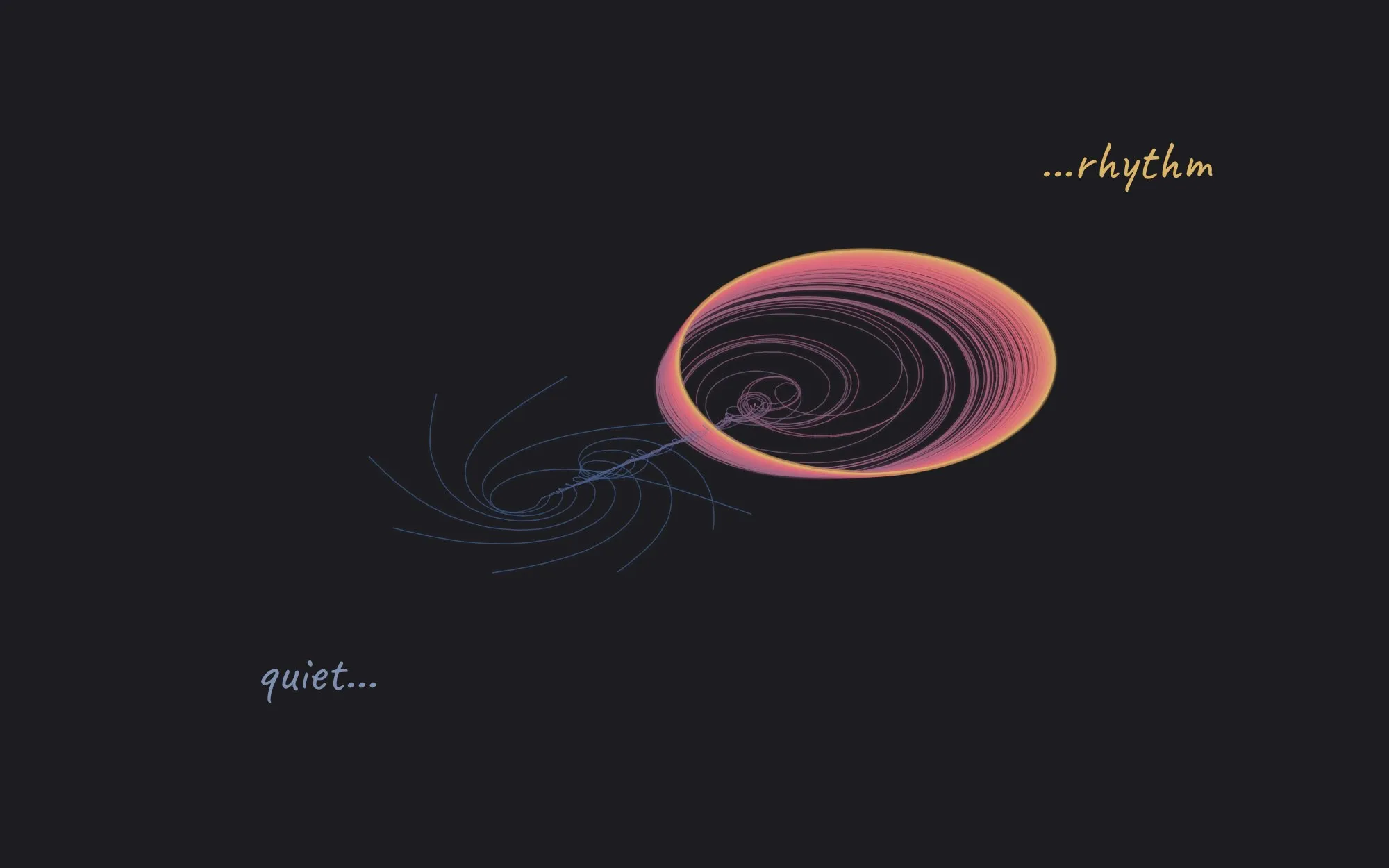
Engineers love machines that do the same thing every time. A good motor controller, a good compiler, a good thermostat: predictable, documented, and designed by someone holding the full wiring diagram. Brains break all of those rules, and the Koay Lab finds that fascinating. Its research page puts it like this: “From an artificial intelligence perspective, we find amazing these functions of the brain that act like a program that can edit itself.”
Three hallmarks
From a dynamical-systems perspective, the lab lists three hallmarks of brain mechanisms that are “qualitatively dissimilar to most if not all human-engineered systems”. The right-hand column is a rough engineering comparison, added for this page:
| The brain can… | Most machines… | |
|---|---|---|
| a | adapt actions to irregular and uncued timings | run on a clock, or wait for a trigger |
| b | compose novel action sequences on the fly, then repeat or innovate on them later | only run sequences someone wrote in advance |
| c | control and modify its own neural dynamics, presumably without any explicit information about its own circuit connectivity | are tuned by an engineer using the blueprint |
What “editing itself” could look like
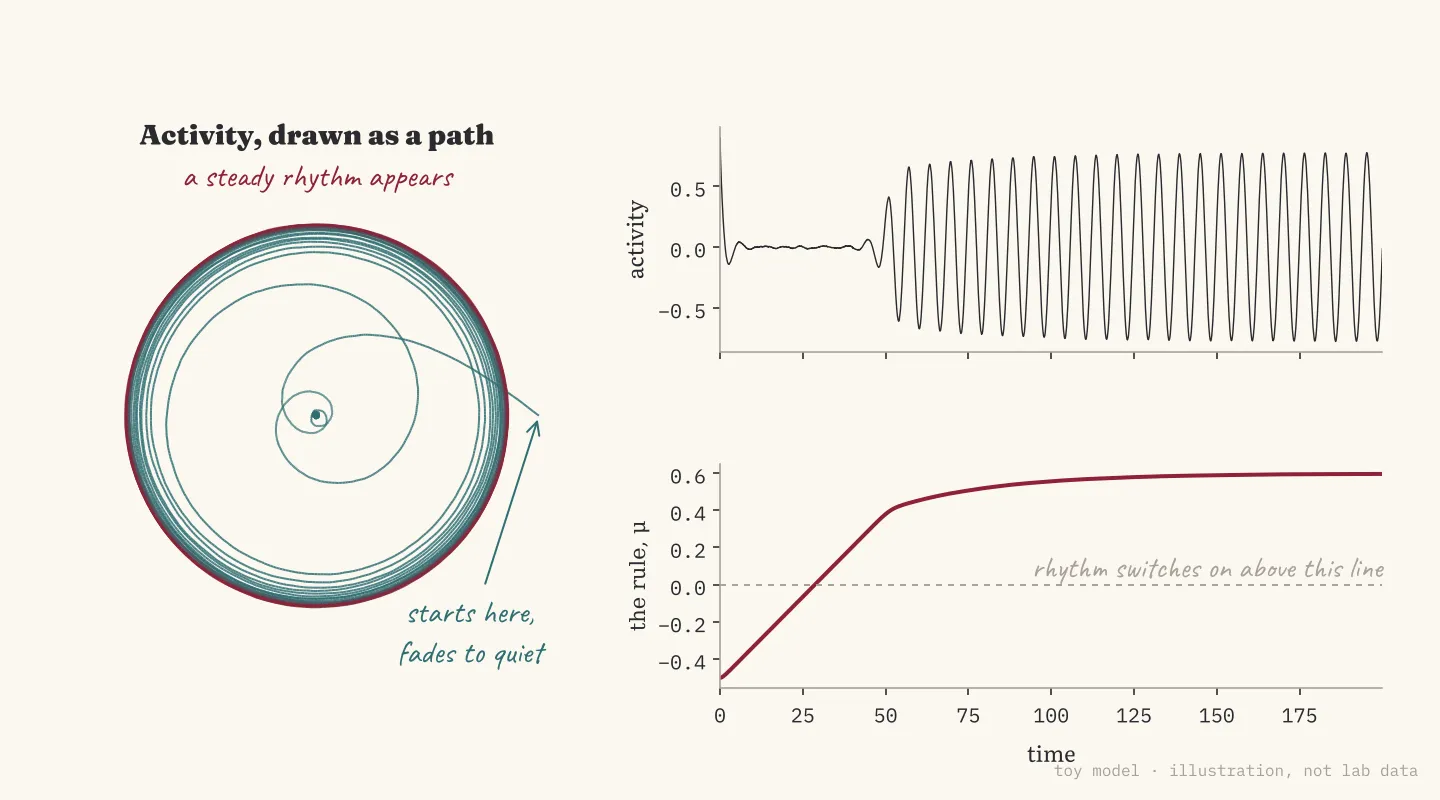
Here is a deliberately tiny example of a system that changes its own rule. Its activity follows a rule set by a single number , and itself drifts, nudged only by how active the system has been:
While is negative, activity dies away to quiet. Quiet counts as too little activity, so creeps upward. Once it crosses zero a rhythm switches on and grows until the activity is just enough (), and settles. Nobody hands the system a wiring diagram: it only ever looks at its own activity.
Not one system, but the whole family
The lab borrows Richard Feynman’s famous line, “What I cannot create, I do not understand”, and adds a postscript: “create” should not mean replicating any one system, but understanding “how to produce the class of systems to which it belongs, including principled variations on the theme”.
So the open questions, in plain words:
- How do actions get timed when nothing in the world says now?
- How are brand-new action sequences composed, kept and improved?
- What rules let a network rewrite its own dynamics without a blueprint?